The Tip Screen Turned Me Into a Villain and All I Did Was Order a Latte
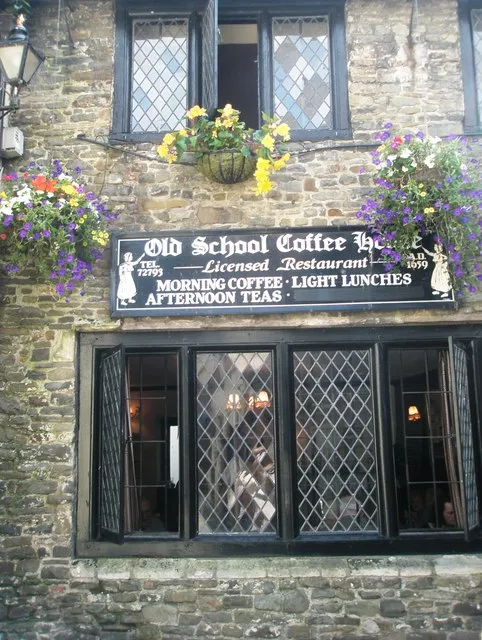
Photo: Basher Eyre, CC BY-SA 2.0, via Wikimedia Commons
I want to be clear about something before we begin. I am not a bad person. I hold doors open for strangers. I let people merge on the highway without making it a whole thing. I have, on multiple occasions, pretended to laugh at jokes that were not funny because I could see the person really needed that. I am, by most reasonable measures, a functioning and considerate member of society.
And yet, last Tuesday, a coffee shop iPad made me feel like I was on trial at The Hague.
Fifteen Dollars. One Beverage. No Regrets. Many Regrets.
Here is what happened. I walked into a café — a perfectly pleasant, exposed-brick, lo-fi-hip-hop-playing café — and I ordered a lavender oat milk latte. Already, yes, I know. But that's not the point. The point is that the drink cost fourteen dollars and seventy-five cents. I'm rounding up to fifteen because my soul needs the cleaner number to process the trauma.
The barista — who was perfectly nice, I want to stress that, this is not about her — punched in my order, spun a tablet around to face me, and then walked away to do literally everything involved in making my drink. The screen blinked to life. It had a question for me.
Would I like to leave a tip?
And then — then — it offered me my options.
Generous. Very Generous. Extremely Generous.
There was a fourth option. It was not labeled. It was a small, grey, slightly ashamed-looking button that said Custom Amount, which is the tip screen equivalent of whispering a confession in a church. And beneath that, buried so deep you'd need an archaeologist and a flashlight, was the option that shall not be named. The one that said No Tip.
It might as well have said I Hate Joy or Please Spit in My Next Order.
A Brief History of How We Got Here
Tipping used to make sense to me. You sit down at a restaurant. A person brings you bread you didn't ask for, refills your water three times, remembers that you wanted the dressing on the side, and talks your table out of making a scene when the kitchen gets the order wrong. That person is working hard, likely making below minimum wage in base pay, and a tip is both customary and genuinely deserved.
I understand that. I respect that. I tip generously at restaurants. I am not a monster.
But somewhere along the way — and I think it happened during the pandemic when everything digital got permanently weird — the tip prompt migrated. It escaped the restaurant. It showed up at the counter-service sandwich shop. Then the smoothie place. Then the self-serve frozen yogurt joint where I weighed my own cup and operated every single piece of equipment myself like a dairy-based intern. And now it lives at the coffee shop, spinning around on its little tablet stand like a game show wheel, waiting to see what kind of person I really am.
The answer, apparently, is the kind of person who stands there for four full seconds doing mental gymnastics while a line forms behind me.
The Psychological Warfare of Tip Screen Design
Let's talk about the engineering of guilt here, because someone put real thought into this and I think they deserve to be acknowledged, in the same way you acknowledge a villain in a movie by admitting they had a pretty good plan.
First, the button sizes. The tip options are large, friendly, and inviting. The no-tip option is small, grey, and formatted in a font that communicates quiet shame. One of these things required a graphic designer to make a deliberate choice, and that choice was: make the customer feel like they're clicking a button that says 'I don't believe in kindness.'
Second, the language. Generous. Not "15%." Not "18%." Generous. As in, you are either a generous human being or you are not, and we would like you to declare yourself right now, in public, with a stranger's drink order pending. The escalating adjectives — generous, very generous, extremely generous — create this bizarre moral ladder where every rung you don't climb means you're a slightly worse person than you could have been.
Third, and this is the part that truly gets me: the screen faces outward. The person behind you in line can see what you pick. I don't know if this is intentional or just a function of how tablet stands work, but the effect is identical either way. You are making a public declaration. Your tip percentage is now a personality trait.
What I Actually Did, Since You're Wondering
I tipped. Of course I tipped. I'm not going to stand in a café and click the grey button of social death while a barista who has done nothing wrong watches me from three feet away. I'm bothered, not heartless.
I clicked Generous, which turned out to be twenty percent on a fifteen-dollar drink, which is three dollars, which means I paid eighteen dollars for a latte I consumed in eleven minutes while standing next to a wall because all the chairs were taken by people with laptops who had clearly been there since the Obama administration.
And I want to be clear: I don't even fully blame the café. The payment software companies designed these screens. Some venture-backed startup somewhere decided that aggressive tip prompting was a feature and not a form of psychological coercion, and now every small business in America is running their checkout on a platform that makes every customer feel like they're being deposed.
The Bigger, More Annoying Picture
Here's the part where I try to wrap this up with something resembling a point, because I have at least that much self-respect.
Tipping culture in America has become genuinely confusing, and I think a lot of people feel the way I do — vaguely guilty, frequently manipulated, and unsure of the actual rules anymore. The system made sense when it was designed to supplement the wages of people doing service-heavy work. It makes considerably less sense when it's applied to every transaction involving a human and a screen, regardless of what actually happened during the exchange.
I'm not against tipping. I'm against being made to feel morally deficient for questioning a twenty-two percent surcharge on a drink I watched someone make in ninety seconds while I stood there holding my reusable cup like a responsible adult.
I'm against the grey button. I'm against the adjective ladder. I'm against the screen being the size of a tablet and facing the public like a confession booth that's been gamified.
I'm against paying fifteen dollars for something and immediately being asked what kind of person I am.
I already know what kind of person I am. I'm the kind of person who tips, complains about it on the internet, and then goes back to the same café next week because the latte is genuinely very good.
I am, in other words, exactly the kind of person this whole system was designed for. And that bothers me most of all.